
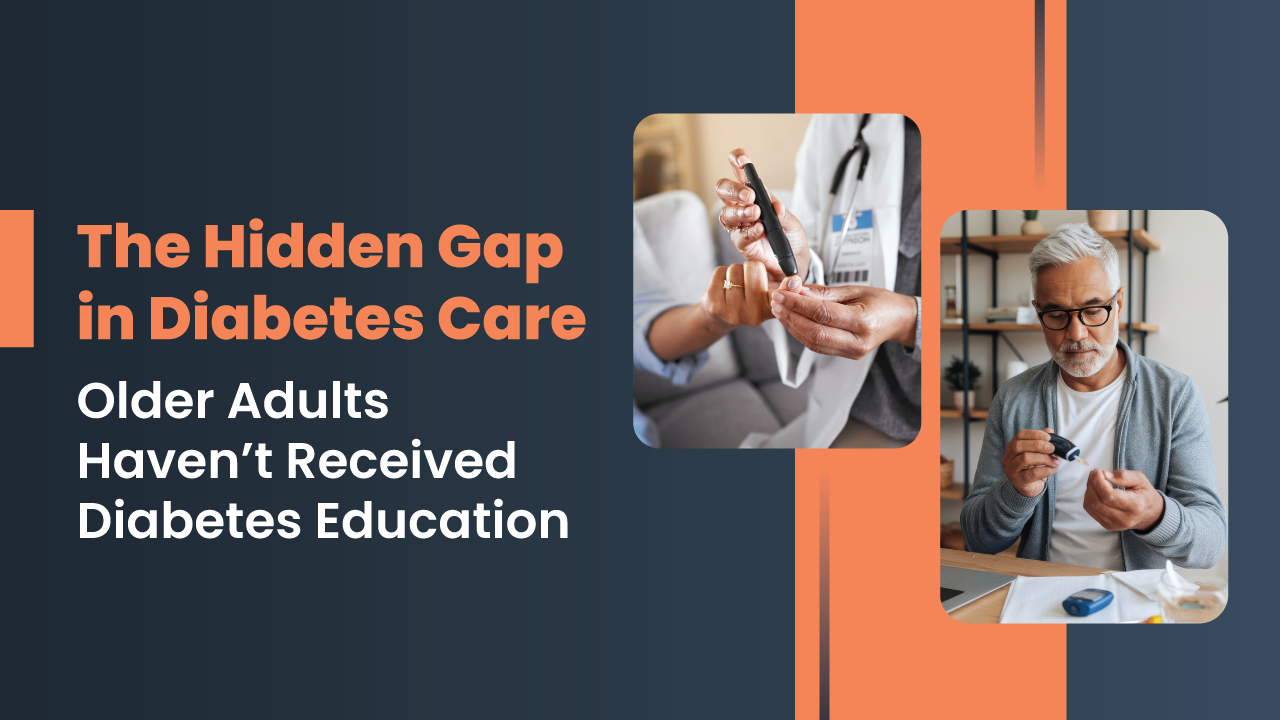
The Hidden Gap in Diabetes Care: Older Adults Haven’t Received Diabetes Education
Diabetes Awareness Month is a reminder of the enormous impact education can have on prevention, self-management, and long-term health outcomes. But new insights from our demographic review reveal a critical challenge1. The majority of individuals living with diabetes have never received any diabetes education nor have they received it in more than a decade.
This gap represents one of the most preventable barriers in chronic disease management. Understanding who is being left behind.
A National Gap: Most People Lack Recent Diabetes Education
Our analysis of diabetes education patterns across key demographic groups shows:
- Nearly two-thirds of respondents have either never received diabetes education or last received it over 10 years ago.
- Only one in four people reports receiving education within the past five years.
In a condition where guidelines, treatment approaches, diet recommendations, and monitoring technologies evolve constantly, outdated education can significantly affect health outcomes.
These findings point to a widespread need for updated, accessible education, especially for groups that have historically been underserved.
Older Adults Are the Majority Across Every Category
One of the most consistent findings across all timing categories is the dominance of older adults (60+):
- They make up the majority of individuals who have never received education.
- They also dominate the groups who received education more than 10 years ago.
This makes older adults the primary population in need of improved, accessible diabetes education.
What this means for health education:
-
Materials must be easy to read, using larger fonts and high-contrast colors.
- Visuals should simplify complex steps (e.g., how to monitor glucose).
- Content must accommodate sensory needs, including hearing and vision changes.
- Printed or hybrid delivery formats may be more effective than digital-only approaches.
Designing materials with older adults in mind is not just good practice — it is essential for reducing the burden of diabetes complications across communities.
Where the Gaps Are Largest: Six States Need Immediate Focus
While the education gap is nationwide, the "never received education" group is concentrated disproportionately in a small group of geographies:
- Maryland
- Texas
- Maine
- New Jersey
- Georgia
Together, these areas account for nearly two-thirds of all individuals who report never having received any diabetes education.
This creates a clear opportunity for tailored outreach:
- Collaborating with local health departments
- Partnering with community health workers
- Delivering culturally relevant and linguistically appropriate materials
- Using community channels preferred by older adults (churches, senior centers, neighbourhood coalitions)
Targeted distribution can significantly improve reach and impact.
Why Diabetes Education Matters More Than Ever
Diabetes education is proven to:
- Improve health, blood glucose control, and understanding of better healthy eating.
- Reduce emergency department visits
- Prevent complications such as neuropathy and vision loss
- Increase medication adherence
- Strengthen self-management skills
- Improve overall quality of life
When individuals understand how to manage their condition from diet to medication to daily monitoring, they make more confident, informed decisions about their health.
This is the essence of equitable chronic disease management: making sure every person has access to the information they need to stay healthy.
How Syra Health Helps Close the Gap
At Syra Health, we use data-driven population health insights to design education and training that is accessible, relevant, and equitable. Our approach includes:
- Demographic and geographic stratification to identify underserved groups
- Tailored curriculum development that meets the needs of older adults and diverse communities
- Community-based distribution strategies to increase reach
- Collaborations with local/state health department for local impact
- Human-centered design to ensure materials are easy to understand and act upon
By combining analytics with compassionate educational design, we help communities build the knowledge they need to manage diabetes effectively.
A Moment for Action
The data is clear - millions of Americans are living with diabetes without the education they need to manage it.
By focusing on older adults, prioritizing high-need geographies, and designing content that is practical and accessible, we can close this gap and transform long-term outcomes.
At Syra Health, we remain committed to supporting communities with educational training programs that are preventive, data-informed, and designed for real-world impact.
References
1 Centers for Disease Control and Prevention (CDC). Behavioral Risk Factor Surveillance System (BRFSS) 2024 Dataset.